Aptitude, Personality, and Interests Are Not Three Votes on Your Career
Aptitude, Personality, and Interests Are Not Three Votes on Your Career
Career advice often places aptitude, personality, and interests in one basket labelled “fit.” The three words can appear side by side on a report, each followed by scores and job suggestions. That layout encourages a simple calculation: if all three point to the same career, choose it; if they disagree, something has gone wrong.
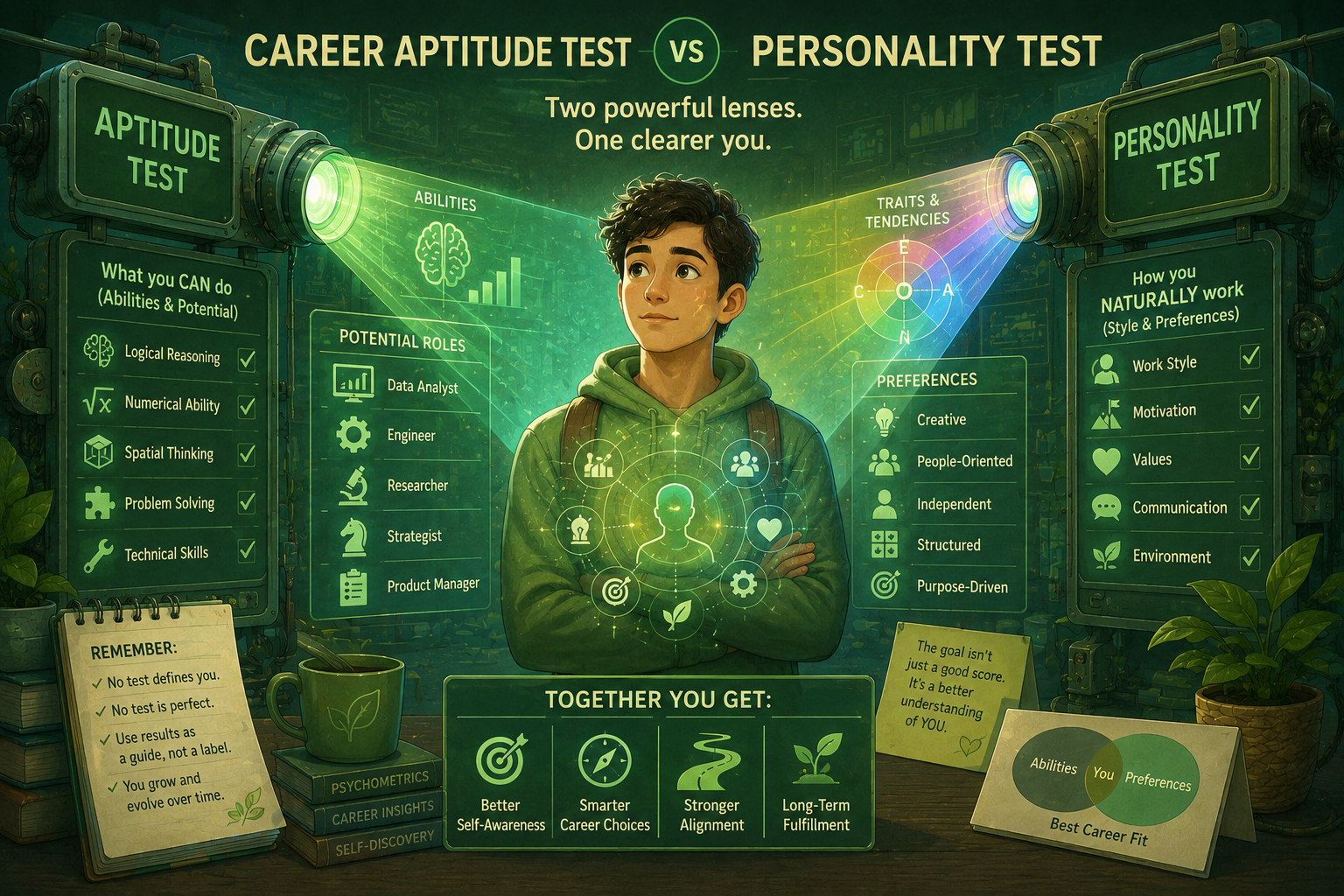
But these signals are not three judges answering the same question. Aptitude asks about your current capacity to learn or perform certain tasks under particular conditions. Interests ask which activities and problems repeatedly attract your attention. Personality describes patterns in how you tend to approach situations, people, risk, structure, and stimulation. A useful career choice does not count their votes. It maps each signal to a different feature of the work—and pays close attention when the relationships conflict.
One career question contains three different relationships
“Would this career suit me?” sounds like one question. It is usually several questions compressed into one sentence.
- Aptitude relates to task demands. How readily can a person learn, perform, or improve the reasoning, spatial, verbal, numerical, physical, or other demands involved?
- Interests relate to task content. Which problems, subjects, activities, and outcomes keep drawing the person back?
- Personality relates to working conditions. Which levels of structure, interaction, novelty, pressure, autonomy, or stimulation make the work easier or more costly to sustain?
These are primary relationships, not sealed boxes. Personality can affect performance. Interest can support the effort needed to develop ability. Experience can change all three. The map is useful because it gives each signal a first question, not because it claims that each signal affects only one part of work.
This also explains why apparent agreement is not proof of a good choice. Someone may show strong numerical aptitude, enjoy analytical problems, and prefer focused independent work. “Data analyst” may look like an obvious match. Yet the actual role may involve cleaning repetitive data, explaining disputed findings to senior stakeholders, or working under constant commercial deadlines. Three personal descriptions cannot substitute for examining the work itself.
The reverse is equally important. Disagreement does not automatically mean that a career is wrong. It identifies a relationship that needs a closer look.
Aptitude: How steep is the learning curve?
The word aptitude is used loosely. Depending on the assessment, it may refer to general cognitive ability, a narrower ability such as spatial reasoning, a work sample, a learned skill, or even confidence in performing a task. Those are not equivalent. Before using a result, it matters what was actually measured and what outcome the score was designed to predict.
Research in personnel psychology consistently finds that cognitive ability can predict learning and aspects of job performance. The relationship is not identical for every task or job. It tends to change with job complexity, the ability measured, and whether the outcome is training success, a work sample, a supervisor rating, or something else.
For career choice, the careful interpretation is practical but limited: aptitude can provide evidence about learning cost and current leverage. It may show that certain demands are easier to master now, that a person already has useful foundations, or that a path will require more deliberate preparation.
It does not create an obligation. Being the quickest person in a class at spreadsheet modelling does not mean a spreadsheet-heavy career deserves decades of attention. High aptitude opens an option; it does not make the option valuable.
Nor does a low score always close a path. It may signal a real difficulty, a weak educational foundation, unfamiliar test content, poor testing conditions, or a demand that can improve with training. The next question is not “Am I allowed to pursue this?” but “What level of performance does the path require, how trainable is the gap, and am I willing to pay that learning cost?”
Interests: Which work keeps pulling attention back?
Interests concern attraction rather than demonstrated performance. An interest inventory may ask whether someone likes analysing data, persuading people, repairing objects, creating images, organising information, or caring for others. It is trying to identify patterns in activities and environments, not certify ability.
That distinction makes interests more useful, not less. In one observational study, more than 3,000 German students were followed for ten years after high school; their vocational interests added information about several later outcomes beyond broad personality traits and cognitive ability. That finding does not establish the same pattern for every population or individual. Meta-analytic research also links interest congruence with performance and persistence. At the same time, the average relationship between interest fit and overall job satisfaction is positive but modest. Interest matters; it is not a happiness guarantee.
One reason is that an attractive subject is not the same as attractive daily work. A person can love psychology and dislike conducting interviews, writing reports, handling confidential records, or studying statistics. Someone can enjoy technology news and dislike debugging software for several hours. Career titles hide the repeated tasks that determine whether an interest survives contact with work.
A stronger interest question is therefore: Which kind of effort do I remain willing to return to after the novelty disappears? Evidence might come from choosing related projects repeatedly, reading beyond what a course requires, tolerating the boring parts of an activity, or noticing which problems continue to occupy attention.
Interest deserves a trial. It does not deserve immunity from reality.
Personality: What conditions raise or lower the cost?
Personality describes relatively broad patterns in thought, emotion, and behaviour. Depending on the framework, a result might refer to sociability, conscientiousness, openness, emotional stability, agreeableness, preference for structure, or another tendency. Personality and vocational interests overlap in some predictable ways, but research does not support treating them as the same construct.
The most common career mistake is to turn a tendency into an occupational ban. A reserved person is told to avoid leadership, sales, teaching, healthcare, or any work involving people. An outgoing person is steered away from analysis. A person who prefers structure is assumed to lack creativity.
Occupations are too broad for those rules. A quiet researcher may enjoy one-to-one interviews and thoughtful synthesis while disliking large networking events. A socially confident analyst may enjoy presenting findings but still need long periods of uninterrupted work. Two jobs with the same title can differ greatly in autonomy, team size, client contact, pace, conflict, sensory load, and predictability.
Personality is often better used to estimate environmental cost. Which conditions require constant self-regulation? Which ones make good behaviour easier? A tendency can matter without becoming a fixed identity. People learn skills, build routines, choose teams, redesign tasks, and behave differently across situations. The relevant question is not “Can an introvert do this job?” It is “Which version of this work would require sustainable adaptation, and which would demand a performance every day?”
Disagreement is not noise. It is the diagnosis
Once the three relationships are separated, conflict becomes more specific.
High aptitude, low interest
This is the competence trap. Other people see reliable performance and keep offering more of the same work. The person may receive praise, grades, promotions, or family approval, which makes leaving the path feel irrational.
Low interest still needs diagnosis. Is the task itself unappealing, or is the current environment repetitive, pressured, or disconnected from a meaningful outcome? Would the same ability feel different in another industry or role? Aptitude can often transfer. Numerical reasoning, for example, appears in finance, operations, policy, research, product work, logistics, and many other settings.
High interest, weak current aptitude
This is a learning-cost decision, not an automatic rejection. The gap may be small and trainable, or it may involve years of education and a demanding professional gate. Enthusiasm should not hide the cost. A score should not pretend the cost is permanent.
The useful evidence is specific: a representative introductory course, a realistic work sample, feedback on repeated practice, and a clear view of the required standard. Progress over time may tell more than one unfamiliar test session.
Attractive work, high environmental friction
Consider a composite computing student who learns logical systems quickly, repeatedly returns to security puzzles, and works well under concentration but badly after frequent unexpected interruptions. His family sees general software engineering as the safer choice because the aptitude and recruitment path are already visible. He is curious about cybersecurity but assumes that every security role means alarms, night shifts, and constant crisis.
The map reveals that the title is hiding several environments. Security operations can involve rapid triage, handovers, monitoring, and on-call incidents. Security engineering may place more emphasis on building controls and reviewing systems. Governance and risk work may involve documentation, policy, and negotiation. Threat research can require long investigations as well as urgent response. The student does not need to decide whether his personality “fits cybersecurity.” He needs to find out which task demands he can meet, which security problems continue to attract him, and which interruption pattern is sustainable.
The family’s stability concern remains legitimate. It simply belongs beside labour-market evidence, training cost, and available routes—not inside an aptitude score.
Turn three signals into one role hypothesis
Choose one real role, not an abstract field, and complete three statements:
- Demand hypothesis: “This role requires ___, and my current evidence is ___.”
- Content hypothesis: “I expect to remain interested in ___ because I have repeatedly ___.”
- Condition hypothesis: “I am more likely to sustain the work when ___, and I need to investigate ___.”
For the composite cybersecurity example, the hypothesis might look like this:
The role requires understanding systems, tracing anomalies, and making decisions with incomplete information; coursework shows a foundation, but time-pressured triage needs testing. The content is attractive because adversarial problems keep drawing attention beyond class requirements. The work is more likely to be sustainable when it includes long investigative blocks and a predictable on-call arrangement rather than continuous alert handling.
Now locate the weakest sentence. Do not take another broad assessment immediately. Find evidence designed for that relationship. The student might join a timed incident-response simulation and record both performance and recovery afterwards. He could compare security-operations, security-engineering, and governance vacancies for interruption patterns, shift expectations, and task mix. Three short capture-the-flag exercises might test whether the attraction survives frustration rather than merely whether the first puzzle is exciting.
If the starting point is a set of scores, first understand what a career assessment result actually means. A construct score and an occupation suggestion are not the same kind of evidence.
The purpose of the hypothesis is not to prove a profile correct. It is to make self-knowledge answerable to the work.
Leave room for what the three signals cannot see
Aptitude, interests, and personality can all look favourable while a career remains a poor choice. The education may be unaffordable. Entry may require a credential the person cannot reasonably obtain. The income may not meet family responsibilities. The local market may offer few openings. The work may conflict with an important value, health need, immigration condition, or desired life outside employment.
The reverse is also possible. A path with imperfect personal fit may be a reasonable temporary choice because it provides income, mobility, training, or access to better options. Career decisions are made under conditions, not inside personality profiles.
This is the counterweight the three-signal map needs. Aptitude can describe leverage. Interests can describe attraction. Personality can describe recurring friction. None can decide what cost is acceptable, what responsibility comes first, or which opportunity exists now.
Self-assessment becomes more mature when it stops trying to name a career and starts improving the relationship between a person and a real piece of work.
Build a three-lens map for a Singapore role
Choose one Singapore role and describe it through three different evidence columns: what the work demands, which tasks hold your attention and which environment helps you function. Then compare those columns with a Skills Framework and occupational data. Agreement strengthens a hypothesis; disagreement tells you what to test next.
Try this worksheet:
- Demand: what must a competent worker do?
- Interest: which recurring tasks attract me?
- Environment: under what conditions do I work reliably?
How this guide was checked
The Singapore mechanics above were checked against current official guidance and datasets; the interpretation was then compared with relevant peer-reviewed research. Official requirements can change, so recheck the linked page before a consequential application or decision.
- SkillsFuture Singapore: Skills Framework
- O*NET: official occupational database
- Nye et al.: vocational interests and performance